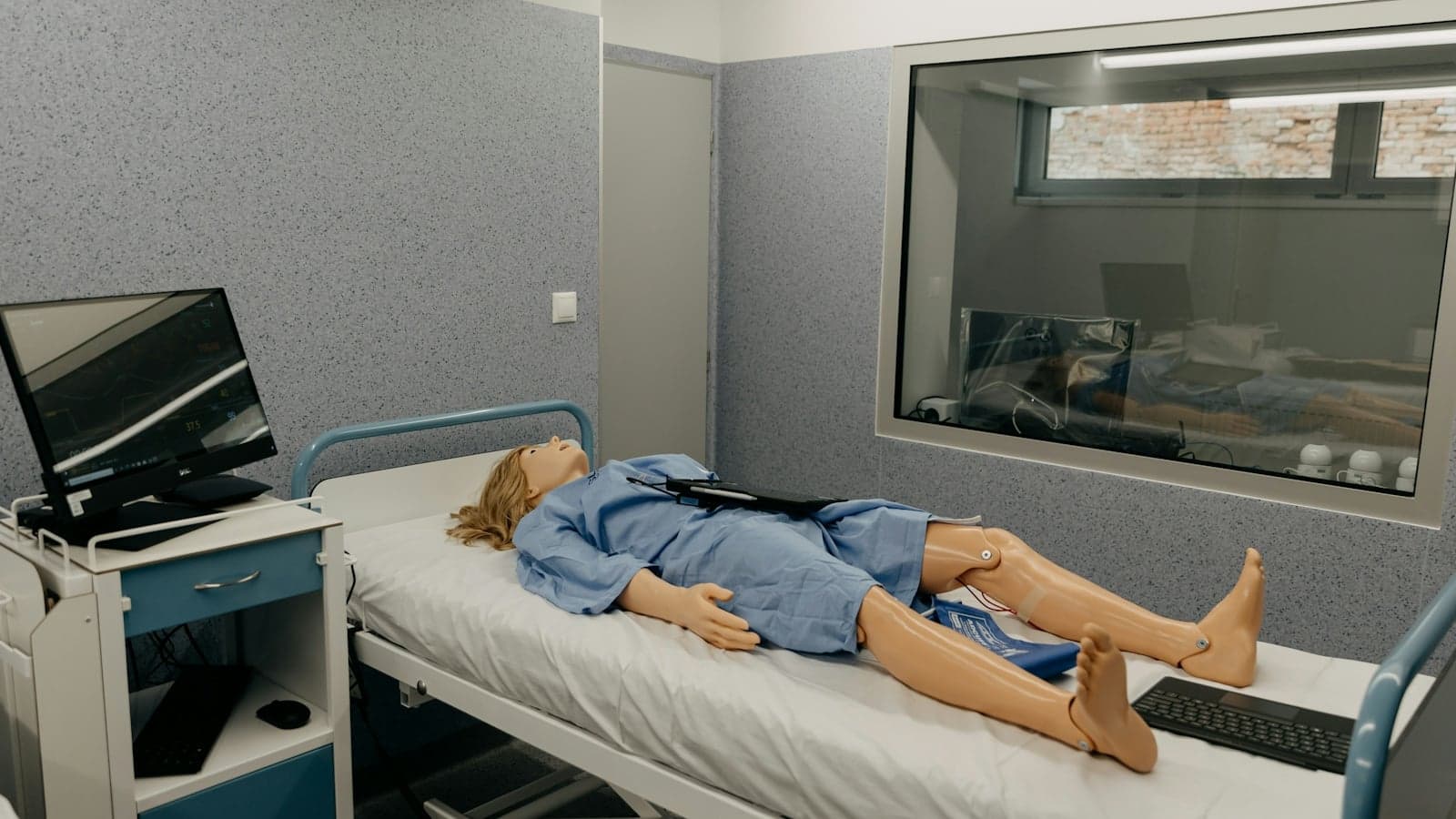
Short answer first: a Canadian nursing degree is credits plus clinical hours, and the hours run the timetable. Saskatchewan's BSN is 130 credit units over four years including a pre-professional year, and one final placement course alone carries 340 clinical service hours. Manitoba expects 1,000 hours of clinical practice before the senior practicum. At the end you write a registration exam that depends on your province and your title: the NCLEX-RN for registered nurses in Ontario and most provinces, the REx-PN for practical nurses in Ontario and British Columbia, and the OIIQ's own professional examination in Quebec.
Every rule below names the province it belongs to, because in nursing almost nothing is national. Your school and your regulator are the authorities for your own case, and both publish the details.
How is a Canadian nursing degree built?
As a set of graded courses with a placement attached to most of them, over four years in the common case. The University of Saskatchewan's Bachelor of Science in Nursing runs four years including a pre-professional year, totals 130 credit units, and asks for a minimum weighted average of 60 per cent across the 30 credit units of the pre-professional year before you are eligible to continue. It is delivered at the College of Nursing campuses in Saskatoon and Prince Albert and at distributed sites including La Ronge, Lloydminster, North Battleford, Swift Current, Weyburn and Yorkton, which is a Saskatchewan answer to a Saskatchewan problem.
Manitoba is built to the same shape with different numbers. The University of Manitoba's Bachelor of Nursing totals 127 credit hours and requires the final seven terms to be completed within six years of admission to the College of Nursing. Quebec runs on its own structure, described below.
What that means for your first week is the same everywhere: the theory courses look like any other science degree, and the clinical courses do not. The weekly rhythm of lectures, labs and placements across a Canadian degree is set out in notes across lectures, tutorials and labs in Canada, and nursing is the version where the placement is the largest block on the page.
How many clinical hours do you actually do?
More than the credit count suggests, and concentrated at the end. Two named examples make the scale concrete.
| Course or requirement | Province | Credits | Clinical hours |
|---|---|---|---|
| NURS 221, Patient and Family Centered Care in Clinical Practice I, U of S | Saskatchewan | 3 credit units | 144 |
| NURS 450, Practice Integration, U of S | Saskatchewan | 9 credit units | 340 |
| Clinical practice before senior practicum, U of M | Manitoba | Not credit-counted separately | 1,000 expected |
The University of Saskatchewan lists 144 clinical service hours for a 3 credit unit clinical course and 340 clinical service hours for the 9 credit unit Practice Integration course, which runs in either term. The University of Manitoba states that students are expected to complete 1,000 hours of clinical practice before starting the senior practicum.
Do the arithmetic once, early. A 340-hour placement over a 13-week term is roughly 26 hours a week of clinical time, on top of the theory courses running beside it, and shifts of 8 or 12 hours can fall on any day, evening or night. That is not a term in which you can also work three shifts a week somewhere else. Students who get into trouble in third year usually got into it in August, when they committed to the hours they had last year.
What may you write down in clinical, and what may you not?
This is the rule that separates nursing from every other degree, so learn it before your first shift rather than after.
Nothing that identifies a patient leaves the unit. Not a name, not a room number, not a date of birth, not a photograph, not a voice. The BC College of Nurses and Midwives states that nurses ensure clients, or their substitute decision-makers, consent to the collection, use and disclosure of their personal and health information, and that consent is valid only if clients understand fully how their information is to be collected, used or disclosed. The same page warns that mobile devices store and retain data, often outside Canada, so there is a risk of unauthorized disclosure. That is British Columbia's wording; Ontario, Alberta and every other province have their own, and your school will have a clinical handbook that says the same thing in its own words.
A recorder is the clearest case of all. Do not record a patient, a family conversation, a handover or a bedside teaching moment. There is no version of that which is fine because your intentions were good. The general question of what you may and may not record at a Canadian university, and why a placement is different from a lecture hall, is covered in recording lectures in Canada.
The three lines you write after a shift
You still need to learn from the day, and you can, without a single identifier.
- The situation, in general terms. "Post-op day one, abdominal surgery, older adult, on a PCA."
- What you did and why. The assessment you made, the intervention, the reasoning behind it.
- The question you could not answer. One line. This becomes your reading that evening and your question for the instructor tomorrow.
Write it in a notebook kept for that purpose, with no names, no initials, no unit, no dates. If a page would let a reader work out who the patient was, it is the wrong page.
Which registration exam will you write?
The answer depends on two things: your province and whether you are registering as a registered nurse or a practical nurse.
| Route | Where | Exam |
|---|---|---|
| Registered nurse | Ontario and most provinces | NCLEX-RN |
| Registered Practical Nurse | Ontario | REx-PN |
| Licensed Practical Nurse | British Columbia | REx-PN |
| Nurse in Quebec | Quebec | OIIQ professional examination |
For registered nurses in Ontario, the College of Nurses of Ontario requires the NCLEX-RN as the entry-to-practice examination. It uses computer-adaptive testing and must be written in person at a testing centre. CNO says Pearson allows candidates to write up to eight times a year, and that a CNO application remains open for a maximum of two years. The same exam is what the University of Saskatchewan tells its students they must pass to be eligible for licensure with the College of Registered Nurses of Saskatchewan, and what the University of Manitoba names for licensure with the College of Registered Nurses of Manitoba.
The practical nurse route is separate. CNO describes the REx-PN as the entry-to-practice exam for applicants becoming a Registered Practical Nurse in Ontario or a Licensed Practical Nurse in British Columbia. It is also computerized adaptive testing, the number of questions ranges from 90 to 150 of which 30 are unscored pretest items, and there is no fixed number of correct answers that equals a pass: you have to sit above a passing standard. There is no limit on attempts, but you wait at least 60 days between them, a maximum of six a year.
Quebec is its own system from start to finish. Université Laval describes two routes into the profession: two years of cégep followed by three years of university, or a three-year technical DEC in nursing followed by two years of university, with access to the profession in both cases after passing the examination of the Ordre des infirmières et infirmiers du Québec. Université de Sherbrooke goes further and requires its nursing students to hold an OIIQ registration certificate from their first trimester and to keep it for the length of their studies. If you are studying in one province and plan to register in another, ask both regulators before your final year, not after it.
How do you study pharmacology without drowning?
Pharmacology fails students for a boring reason: they treat it as a reading subject. It is a memory subject with a clinical layer on top, and memory subjects respond to being tested rather than reread.
A 2023 scoping review in Nursing Education Perspectives searched five databases and found 25 nursing education studies of retrieval practice, all but one of them at the prelicensure level, and describes retrieval practice, recalling previously learned information from long-term memory before studying it again, as one of the most highly effective strategies the science of learning has produced. The review's own conclusion is about the state of the research rather than a promise about your grade, so take it as support for the habit, not for any one app.
A drug card that works
Five fields, no more, or you will stop making them.
- Class and mechanism, in one line you could say out loud.
- What it is given for, in the words a patient would use.
- The adverse effects that change your action, not every effect listed in the monograph.
- The nursing assessment before and after. What do you check, and what number stops you giving it.
- Patient teaching, one sentence.
Make them the week you meet the drug, not in April. Then review on a schedule instead of by mood: the point of spaced repetition is that September's antihypertensives come back in November while you are on a cardiac unit, which is exactly when they mean something. Turning a week of lecture notes into cards is mechanical once the notes exist, and the method is in making flashcards from your notes.
The last step is the one that separates a nursing exam from a biochemistry exam. Take five cards and write one case question that uses all of them. The exam will not ask what a beta blocker does. It will give you a heart rate of 48, a dose due at 09:00, and four plausible actions.
How do you write a care plan that teaches you something?
Most students write care plans for the instructor and learn nothing from them. Write them for yourself, in four moves, and the same page becomes revision.
- The data that made you name the problem. Not "risk for impaired skin integrity" on its own, but the Braden score, the redness, the days immobile.
- The outcome, with a number and a date. "Ambulates 20 metres with a walker by day three" can be checked. "Improved mobility" cannot.
- Each intervention with its reason attached. The reason is the part that becomes a question later.
- How you will know it worked, and what you will do if it did not.
Keep the plans from each placement in one file per specialty. By fourth year you have your own worked cases in medicine, surgery, maternity, mental health and community, which is a better exam resource than any commercial question bank, because you were there.
What does a week in a placement term look like?
Roughly this, for a student carrying a clinical course and two theory courses in the same term. The numbers come from the hours above, not from a template.
| Day | What is on it |
|---|---|
| Monday | 12-hour shift, three lines written after it, 20 minutes of drug cards on the bus |
| Tuesday | Theory lectures, one hour of retrieval on last week's cards |
| Wednesday | 12-hour shift, three lines, one question for the instructor |
| Thursday | Lab or seminar, care plan written properly, two hours |
| Friday | Theory lectures, one hour of retrieval, one case question built from five cards |
| Weekend | One longer block of reading, one rest day that is actually a rest day |
Two rules make the week survive contact with reality. The first is that the 20 minutes after a shift are worth more than two hours on Sunday, because that is when you still remember what the patient looked like. The second is that the rest day is part of the plan. Placement terms are physically tiring in a way that lecture terms are not, and a student who studies through every day off arrives at the exam period already finished.
Where Notibo fits
Nursing theory courses are dense and fast, and the term when you most need good notes is the term when you are on the unit for 26 hours a week. Notibo records a lecture, or takes an audio file you upload, and returns a transcript, structured notes and flashcards with spaced repetition, so a pharmacology lecture from September is still a set of questions you can answer in March. It also turns PDF, PPTX and DOCX files into notes and flashcards, which covers the slide decks, the drug monographs and the course readings you were given as PDFs.
One boundary matters more here than in any other subject. Use it in the lecture hall, with your instructor's permission, and never on a unit. Do not record patients, families, handovers or bedside teaching. Files are stored in the EU, on Supabase in Frankfurt, while transcription and the AI notes run on US processors under standard contractual clauses, which is a good reason on its own to keep anything clinical away from it. Pro is free to try for 14 days with no card, and the trial includes 240 minutes of recording. Afterwards the free plan is 30 minutes of recording a month. Pro is 9.99 euro a month or 88.99 euro a year, in euro rather than Canadian dollars, with the local amount shown at checkout. Uploads are capped at 50 MB, and long recordings are saved in smaller parts as they run and joined back into one transcript. See the pricing page for what the plans include.