Skip to content

How to take notes in lectures, tutorials, labs and placements

By · Notibo

Published · 19 min read · updated

Key takeaways

  • A lecture note captures the argument's shape, a tutorial note the correction to your own problem set, a seminar note the objections, and a lab notebook records what you actually did, in ink, as you do it.
  • UTSC says review your notes and turn them into questions within 24 hours of the lecture. Queen's says take five minutes after class to write a summary. Same day, twenty minutes, is the step most students skip.
  • Waterloo's teaching centre says that in large classes the tutorial may be the only time you get expert feedback on your work. A rubric U of T publishes marks you on whether the group learned more because you were there.
  • SFU's PHYS 233 makes the lab notebook 60 per cent of the grade, in ink, in a bound book, checked before you leave. McMaster's chemistry manuals say never erase, and record as the experiment proceeds, not later.
  • On placement the rules come from the regulator. Ontario's social work college requires client consent before any photographing or audio or video taping. Write about what you learned, never about who.

Short answer first. A lecture note captures the shape of an argument, because one person is delivering it to a room and you need its structure. A tutorial note captures the correction to work you already did, because the problem set is the content. A seminar note captures what other people said, because the objections are the course. A lab notebook records what you actually did, in ink, as you do it. An office-hours note records the answer to a question you brought. A co-op journal records what you did on a work term so that the report writes itself. A placement note records what you learned without recording who you learned it from.

Same degree, seven different jobs. Nearly all note-taking advice assumes a lecture hall, and the lecture hall is often not where the marks are decided.

What does a week at a Canadian university actually contain?

Your timetable is not one format repeated. Waterloo's guide for incoming students puts the first change plainly: "For some classes, you'll be in a classroom for only three hours a week", and "Readings and assignments are just as important as the content covered in lectures." Those three hours are usually split between rooms.

  • The lecture. One person speaking, often to a large room in first year, sometimes captured on video.
  • The tutorial. A small section of that lecture course run by a teaching assistant. Waterloo's Centre for Teaching Excellence describes three kinds: discussion-based, problem-solving, which is "common in math, science and engineering", and review sessions where "students ask questions about the course content and assignments".
  • The lab. A bench, a partner, a notebook that is marked.
  • The seminar. The upper-year course that is small by design.
  • Office hours. The one room where the timetable belongs to you.
  • The work term and the placement. Rooms outside the university where the rules come from an employer or a regulator.

Open your timetable and count the contact hours that are not lectures. That number is how much of your week has no note-taking method behind it.

Lectures: what do you write when you cannot write everything?

McGill's student learning resources start with the mechanics: "Write in phrases, not sentences", "Record key words", "Use abbreviations and symbols", and summarise in your own words. UTSC's learning strategies page adds what to listen for. Copy the learning objectives if the professor lists them at the start. Notice repetition, because "professors emphasize the importance of different topics or skills by spending more time on them". Watch for transitional phrases, "in summary", "in conclusion", "first, second, third", because they mark the points and the processes. And leave spaces in your notes to fill in afterwards from the textbook, a peer or the instructor.

Decide what you are writing before it starts

The slides already exist. The note has to capture what is not on them.

  • The skeleton. The sections and the question each one answers.
  • What was said out loud but is not on the slide. The aside, the qualification, the reasoning between two bullet points. This exists nowhere else.
  • Worked examples in full. Including the steps that looked obvious while you were watching.
  • A mark in the margin for anything you did not follow. It keeps you moving instead of stalling on one line.

Queen's SASS is blunt about the laptop. It cites research that "students who take notes on laptops perform worse on tests than students who take notes by hand", and then makes the point that matters more: what counts is "what you are doing when you're taking notes, not how you're writing them". Paraphrase the main idea, write down your questions, and do not transcribe. Queen's, McGill and UTSC all describe the Cornell method, with a cue column beside the notes and a summary underneath, and UTSC tells you exactly where to draw the line: 2.5 inches from the left. It is a lecture format. It does not suit a lab and it does not suit a seminar, and the rest of this article explains why.

Within 24 hours

UTSC's academic advising centre gives the timing as a rule rather than a suggestion: "Within 24 hours of the lecture, review your notes and generate relevant questions and/or key phrases." The questions go in the key column, and later you cover the notes and answer them. Queen's is shorter still: as soon as possible after class, take five minutes to write a summary, then a weekly summary sheet once the week's classes, tutorials and labs are done.

Twenty minutes, same day. Read the page once. Turn every margin mark into a question you can answer or cannot. The ones you cannot go on a list for the tutorial.

Tutorials: what do you write when the TA is marking your participation?

A tutorial is not a small lecture, and writing it as one gives you a worse copy of a note you already own. Waterloo's teaching centre tells TAs that "with large classes, tutorials may be the only time when students can get expert feedback on their work". That is what the room is for, and the note should be built around it.

It is also, in many courses, graded. A tutorial participation rubric that U of T's teaching centre publishes puts 40 per cent on participatory contribution, 30 per cent on intellectual contribution, which is preparation and the quality of your comments, and 30 per cent on your effect on the group. The A grade goes to a student without whom "the quality of the learning experience for the entire group would have been inferior". The rubric also says that "speaking directly to the instructor is also highly discouraged", that dominating the discussion is not helpful, and, on the reading, "If you haven't, it will become clear quite quickly."

Prepare questions, not summaries. Arrive with the two questions the problem set or the reading left you with, written down, so you have something to say in the first ten minutes rather than the last two. Use one of them.

What goes on the page

  • The problem you got wrong, and the step where it went wrong. Not the full solution again. The TA will post that. The line where your method left the road is the only line you need.
  • The question, in the words it was asked in. The wording is half of what is being taught.
  • The answer that was wrong, and the sentence that fixed it. A wrong answer corrected in front of you shows the boundary of the concept.
  • Anything a classmate said that you would not have thought of. Gone by tomorrow otherwise.
  • Anything about the assignment or the midterm, word for word, with the date. In week ten, when your memory of the brief and the brief itself disagree, you want the sentence.

Then stop. You are not transcribing the TA.

Keep a running list of your own recurring errors across the term. By week six the list is short and the same three things are on it. That list is worth more in the exam period than any set of lecture notes, and it feeds straight into how to prepare for exams at a Canadian university.

Seminars: what do you write when the discussion is the course?

By third year the large lecture gives way to the seminar, a course of fifteen or twenty where the reading is assumed and the two hours are spent arguing about it. The participation rubric above was written for exactly this room, and its logic holds: you are being marked on whether the group learned more because you were there.

That changes the note. In a lecture you receive a position. In a seminar you defend one, and the content of the two hours is the gap between what you thought the reading said and what the room thinks.

  1. Before. One page: the author's claim, the evidence for it, and the weakest link in the chain. Naming the weak link yourself is the exercise, and someone will find it in the first ten minutes if you do not.
  2. During. Objections to your own position, in the objector's words. Not your paraphrase. The one you could not answer goes at the top of the page and becomes the counterargument section of your essay.
  3. The question nobody answered. Circle it. That is next week's reading, and it is the question the essay should be about.
  4. Within 24 hours. Rewrite your claim so it survives the objections. If it cannot be rewritten, you have learned more than a tidy page would have taught you.

Labs: what has to be in the lab notebook?

The lab is the one format where the note records an event rather than an idea, and where marks attach to it directly.

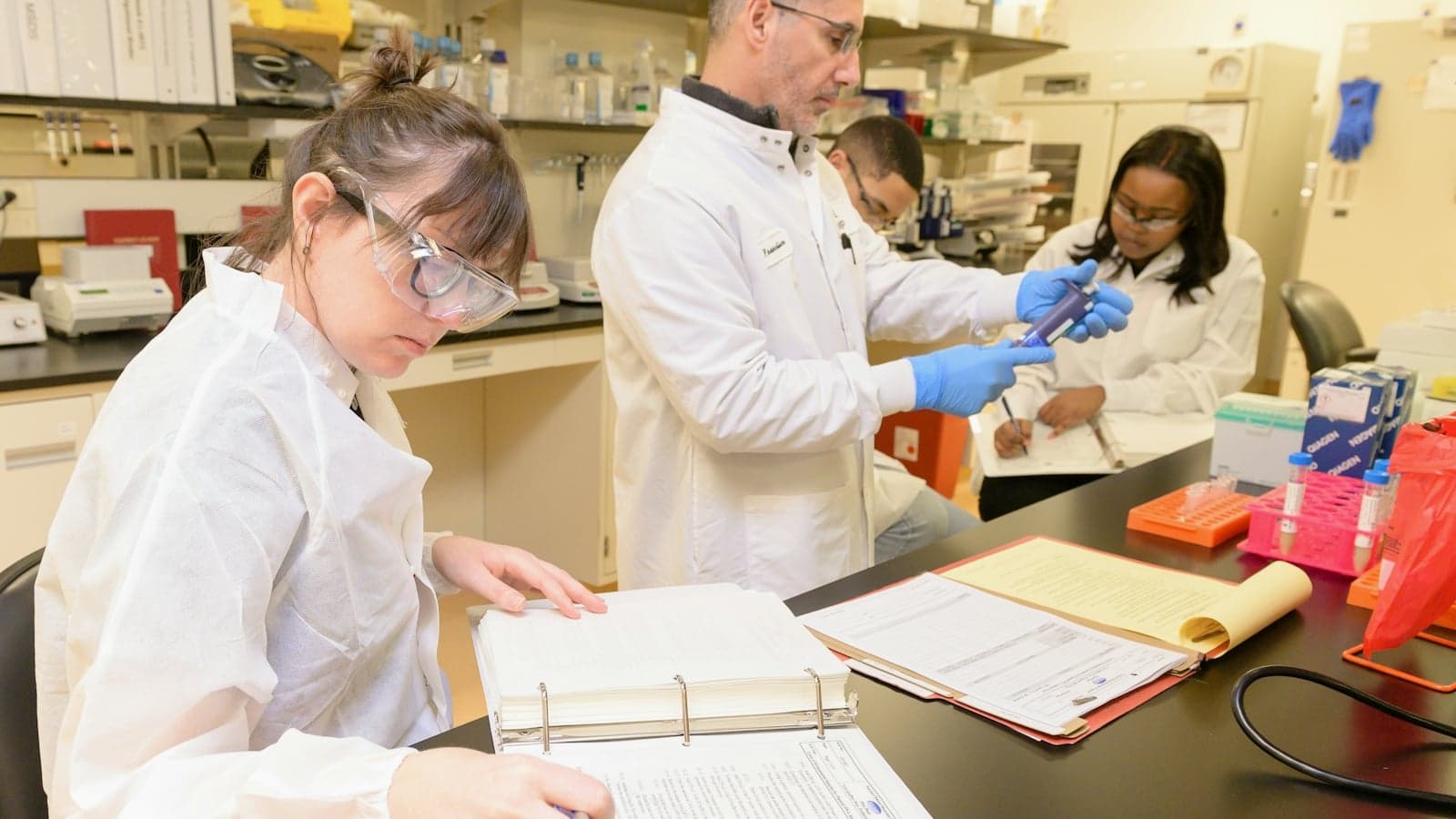
SFU's PHYS 233 reference manual makes the notebook 60 per cent of the grade. The book must have fixed pages with graph paper, because you graph directly into it, and "loose pieces of paper are not allowed and will not be marked". You date every entry, "considering your lab book like a diary of events". The instructor or TA checks the book before you leave at the end of the day, and the manual is explicit about why: "We do not want you to go back and fill in details later." The description of the genre is the best short one we found. The notebook is "the permanent record of everything you do in connection with the laboratory course", it should let you "reconstruct a full account of an experiment that you have long since forgotten", no formal sentence structure is required, and "most likely, it will not be neat", but "it must be legible and permanent (i.e., in ink)". Mistakes stay in, with an explanation of what went wrong. Computer files get unambiguous names, and the names and directories go in the book.

McMaster's chemistry lab manual says the same thing from a different bench. A notebook with duplicate copies is required. "Always use a pen, so that errors are crossed out." "Never erase an entry in your lab book!" The title, purpose, summary and pre-lab questions are written before you arrive, and the data, "yield, melting points, etc.", go in "as you go". On presentation: "A notebook should be neat but need not be a work of art. Clarity of procedure and results are what count." An earlier McMaster manual is even more direct about timing: "DO NOT make rough notes in this manual or on any scrap paper: USE your notebook for all records", and record "as the experiment proceeds (NOT later, when you get to your room!)".

UTSC's first-year chemistry outline adds the two things that come before the first entry. The book "must be hard-cover, permanently bound (not spiral or loose leaf)", and you buy approved splash goggles and a lab coat before the first lab or you do not take part. Failure to follow the manual's rules "will adversely affect your lab mark".

The three-column bench note

Put those together and the method writes itself. Run three columns.

  1. What the instructions say to do. Refer to the manual by page rather than copying it. SFU wants "a list of equipment used and how it was used", and notes that "this may differ from the lab script".
  2. What you actually did. Deviations, the reagent you substituted, the instrument that needed recalibrating, and your reason for any change, written in as they happen. SFU asks for exactly this: an account of what you actually did, what worked and what did not, and the limitations of the equipment.
  3. What you observed, with units and times. Full sentences for anything odd. Your estimate of how accurate each measurement is and the main sources of error, which SFU says to write down at the bench. File names and locations for anything the computer recorded.

Column two is the one everybody skips and the one the write-up needs, because the method section of a report has to describe the experiment that happened rather than the one that was planned. Column three is where the discussion comes from, and the anomaly that is obvious at the bench on Tuesday is gone by Sunday.

The write-up comes later. What you do the same day is check the book against SFU's test, could you reconstruct the whole experiment from it, and note which observation in column three you cannot yet explain. That unexplained observation is the discussion section.

Office hours: what do you write when you asked the question?

McGill's office hours page defines them as "designated times when you can speak with your instructor or teaching assistant (TA) outside of class", and says to prepare "by reviewing your notes, skimming assigned readings, and checking other course materials" and to "have a clear plan of the questions that you would like to ask". For anything that needs half an hour or more, or in a busy week, it suggests emailing to book a time instead of dropping in.

The note here is short and it is mostly written before you walk in. The question, in one sentence. What you already tried, in one line, so the instructor can see where you got stuck rather than starting from zero. Then, in the room, the answer in the instructor's phrasing, not yours, and the thing they said in passing that was not the answer to your question but should have been. Most of what office hours teach is in that last line. Within 24 hours, go back to the lecture note the question came from and fix it, so the correction lives where you will revise from.

Co-op work terms: what do you write when the report is due in week two?

At Waterloo and the other co-op universities, a work term ends with a report, and the report is due when you are back in classes with everything else. Waterloo's co-op office says that "all co-op students complete MRRs as part of Professional Development (PD) course requirements", that for Arts, Environment, Health, Math and Science the major reflective report fulfils the reflection requirement of the co-op designation, and that "several Engineering programs require work term reports to meet program requirements", submitted to the faculty for grading. Which one you write depends on your program, and the page sends you to the academic calendar for the details.

Whichever it is, the report is written from a journal you either kept or did not. Fifteen minutes on Friday, every week of the term.

  • What you worked on and what changed. The problem as it was handed to you and the problem as it turned out to be.
  • One thing you learned that the degree had not taught you. A tool, a convention, a way the industry does something the textbook does differently.
  • One thing you would do differently. This is the reflection the report asks for, and in week two after the term it is unrecoverable from memory.
  • What you can say. Most employers have you sign something about confidentiality. Note at the time what is public and what is not, because the report has to be written from the first pile only.

Placements: what do you write when you cannot record anyone?

Nursing, education and social work students spend large parts of the degree in rooms full of people who are not there to be studied. The rules come from the provincial regulator, not the university, and they are stricter than any lecture policy.

The College of Nurses of Ontario's confidentiality standard opens by saying that "standards apply to all nurses regardless of their role, job description or area of practice", and nursing students are assessed against them on placement. The indicators read like a set of rules for a notebook. Collect "only personal health information that is needed to plan and provide care". Do not discuss client information "in public places such as elevators, cafeterias and hallways". Safeguard "computerized, printed or electronically displayed or stored information against theft, loss, unauthorized access or use, disclosure, copying, modification or disposal". Do not use "standard e-mail to send personal health information". And the obligation "continues indefinitely" after the nurse stops caring for the client.

The Ontario College of Social Workers and Social Service Workers says it outright in Principle V of its code: "College members obtain clients' consent before photographing, audio or video taping or permitting third party observation of clients' activities." The same principle explains that clients must be told when information will be shared with "social work or social service work students", and that where cases are used for education, confidentiality is ensured "through the alteration and disguise of identifying information". For teacher candidates, the Ontario College of Teachers' professional standards put Respect and Trust among the four ethical standards, with Respect including modelling respect for confidentiality, and Trust built on professional relationships with students, parents and guardians.

None of that needs to say "do not record a ward round" or "do not record a Grade 4 classroom". A phone recording either one captures patients and children who did not consent, and every one of those standards is written to prevent exactly that. Other provinces' regulators publish the equivalent, and your program will tell you which one you are held to.

The placement notebook

  • Learning, not people. Write what you learned about the condition, the technique, the classroom strategy. No names, no dates of birth, no bed numbers, no initials, no anything that identifies a patient, a pupil or a client.
  • Reflection, same day. What you did, what you would do differently, what you need to ask your preceptor or associate teacher. Most programs assess reflective writing and this is its raw material.
  • Questions for the university. The gap between the textbook and the ward or the classroom goes in a list you bring back to the seminar.
  • Where the book lives. Not on a shared drive, not photographed into a group chat, and, if it is on a phone, not in an app that uploads it anywhere.

Paper is the safest format on a placement, and in most placements the only one your preceptor will be comfortable seeing.

Can you record any of it?

The lecture is the one room where recording is sometimes allowed, and even there the answer is the instructor's to give. Universities and faculties word it differently, and recording lectures in Canada goes through the policies one by one. In a tutorial you would be recording twenty classmates who did not agree to it. In a seminar you would be recording your own argument being taken apart. On a placement you would be recording patients, pupils or clients, and the regulator's standard already answers the question. Record the lecture, with permission. Everywhere else, write.

How do you pull seven notebooks back into one course?

Twelve or thirteen teaching weeks, a short gap, then the exam period, and the gap has to serve every course at once. Reconciling seven kinds of note in that week is not a plan. Queen's suggests a weekly summary sheet once the week's classes, tutorials and labs are done, and that is the right unit.

The weekly page

Twenty minutes per course, one page.

  • The lecture's argument, in three sentences. If you cannot get it to three, you did not follow it.
  • The tutorial correction you did not see coming. And the pattern it belongs to on your running list.
  • The seminar objection you could not answer. In the objector's words.
  • The lab observation you cannot explain. Or the placement question for the university, or the thing from the work term the degree had not taught you.
  • The open questions. Carried forward until they are gone.

That page is the only one of the seven notebooks that is automatically in your own words, because nobody else sat through your combination of confusions. Turn the open questions into cards and start active recall in week three rather than in the week before the exam. If the course goes badly in December, the notes from September are what you will be working from in April.

Where Notibo fits

Notibo records a lecture, or takes an audio file you upload, and returns a transcript, structured notes and flashcards with spaced repetition. It also turns PDF, PPTX and DOCX files into notes and flashcards, which covers the slides and the lab manual's briefing pages. It transcribes 89 languages including Canadian English and French. The free plan is 30 minutes of recording a month, and a full term of 50-minute lectures means Pro at 9.99 euro a month with a seven-day trial, or 99.99 euro a year, billed in euro rather than Canadian dollars with the local amount shown at checkout. Uploads are capped at 50 MB, and long recordings are split into 30-minute files on the phone and joined into one transcript.

Audio is stored in the EU and sent to processors in the United States to be transcribed, so it is the wrong place for anything from a placement, and you need the instructor's permission before you record. It helps in the room where one person is speaking. In the tutorial, the seminar, the lab, the work term and the ward, the writing is still yours to do. There is more on the recording side at lecture recording.

Frequently asked questions

What is the difference between a tutorial and a seminar at a Canadian university?
A tutorial is the small section attached to a large first- or second-year course, run by a teaching assistant. Waterloo's teaching centre describes three kinds: discussion-based, problem-solving, which is common in math, science and engineering, and review sessions where students ask questions before a test. A seminar is an upper-year course that is small by design, where the reading is assumed and the discussion is the course. The tutorial note records the correction to your own work. The seminar note records what other people said.
Should I type or handwrite in a lab?
Handwrite, in the lab, as it happens. SFU's physics reference manual says the notebook must be legible and permanent, in ink, that loose pieces of paper are not allowed and will not be marked, and that the instructor checks the book before you leave. McMaster's chemistry manual says always use a pen so that errors are crossed out, and never erase an entry. A crossed-out reading with the correction beside it is the right record.
Does tutorial participation count towards my grade?
Often, and the weighting is in the course outline. A tutorial participation rubric that the University of Toronto's teaching centre publishes puts 40 per cent on participatory contribution, 30 per cent on preparation and quality of comments, and 30 per cent on your effect on the group. It says evaluation is based in large part on whether you improved the learning experience of your peers, that speaking only to the instructor is highly discouraged, and that if you have not done the reading it becomes clear quite quickly. Bring two written questions and use one.
Can I record a tutorial, a lab or a placement?
No. In a tutorial you would be recording twenty classmates who did not agree to it. In a lab your hands are wet and your phone should be in your bag. On a placement the people in the room are patients, pupils or clients. The Ontario College of Social Workers and Social Service Workers requires client consent before photographing or audio or video taping, and the College of Nurses of Ontario's confidentiality standard applies to all nurses regardless of role or area of practice. Recording a lecture is a separate question, and it needs the instructor's permission. Everywhere else, write.
What do I do with lecture notes in the first 24 hours?
Read them once, the same day, and turn the margin into questions. UTSC's academic advising centre says to review your notes and generate questions or key phrases within 24 hours of the lecture, using a key column drawn 2.5 inches from the left of the page. Queen's Student Academic Success Services says to take five minutes as soon as possible after class to write a summary, then a weekly summary sheet once the week's classes, tutorials and labs are done. Twenty minutes is enough.
What goes in a co-op work term report?
It depends on your faculty. Waterloo's co-op office says all co-op students complete major reflective reports as part of the professional development courses, that for Arts, Environment, Health, Math and Science the reflective report fulfils the reflection requirement of the co-op designation, and that several Engineering programs require work term reports submitted to the faculty for grading. Whichever you write, the raw material is a work journal you kept during the term, not your memory of it in the first week back.
What does a week at a Canadian university actually contain?
Your timetable is not one format repeated. Waterloo's guide for incoming students puts the first change plainly: "For some classes, you'll be in a classroom for only three hours a week", and "Readings and assignments are just as important as the content covered in lectures." Those three hours are usually split between rooms. The lecture. One person speaking, often to a large room in first year, sometimes captured on video. The tutorial. A small section of that lecture course run by a teaching assistant.
Lectures: what do you write when you cannot write everything?
McGill's student learning resources start with the mechanics: "Write in phrases, not sentences", "Record key words", "Use abbreviations and symbols", and summarise in your own words. UTSC's learning strategies page adds what to listen for. Copy the learning objectives if the professor lists them at the start. Notice repetition, because "professors emphasize the importance of different topics or skills by spending more time on them". Watch for transitional phrases, "in summary", "in conclusion", "first, second, third", because they mark the points and the processes. And leave spaces in your notes to fill in afterwards from the textbook, a peer or the instructor.

Sources

  1. Note Taking and Listening (University of Toronto Scarborough, Academic Advising and Career Centre) (PQ5R system; key column 2.5 inches from the left; review notes and generate questions within 24 hours of the lecture)
  2. Note-Taking (Queen's University, Student Academic Success Services) (handwriting research; paraphrase the main idea; five-minute summary as soon as possible after class; weekly summary sheets; Cornell layout)
  3. Reading and note-taking (McGill University, Student learning resources) (write in phrases, record key words; five methods including Cornell; add prompts and summary after class)
  4. Key Strategies for Effective Tutorials (University of Waterloo, Centre for Teaching Excellence) (three tutorial formats; in large classes tutorials may be the only time students get expert feedback on their work)
  5. The Laboratory Notebook, Chem 2OB3 lab manual (McMaster University, Department of Chemistry) (duplicate-copy notebook required; always use a pen; never erase; neat but need not be a work of art; record data as you go)
  6. PHYS 233 Reference Manual (Simon Fraser University, Department of Physics) (notebooks worth 60 per cent; fixed numbered pages; in ink; loose paper not marked; checked before you leave; three parts before, during, after)
  7. Work term reflections and reports (University of Waterloo, Co-operative Education) (all co-op students complete MRRs; several Engineering programs require work term reports graded by the faculty)
  8. Confidentiality and Privacy, Personal Health Information practice standard (College of Nurses of Ontario) (standards apply to all nurses regardless of role; collect only what is needed; no client discussion in public places; safeguard electronic and printed information)

About the author

Farhad Ba-Ali

Farhad Ba-Ali builds Notibo in Odense, Denmark. He writes about study methods, memory and note-taking from the questions students send in, and from what the product's own data shows.

Ready to take better notes?

Let Notibo listen along and write your notes and summaries. Free to get started.

Create free account

Back to the blog