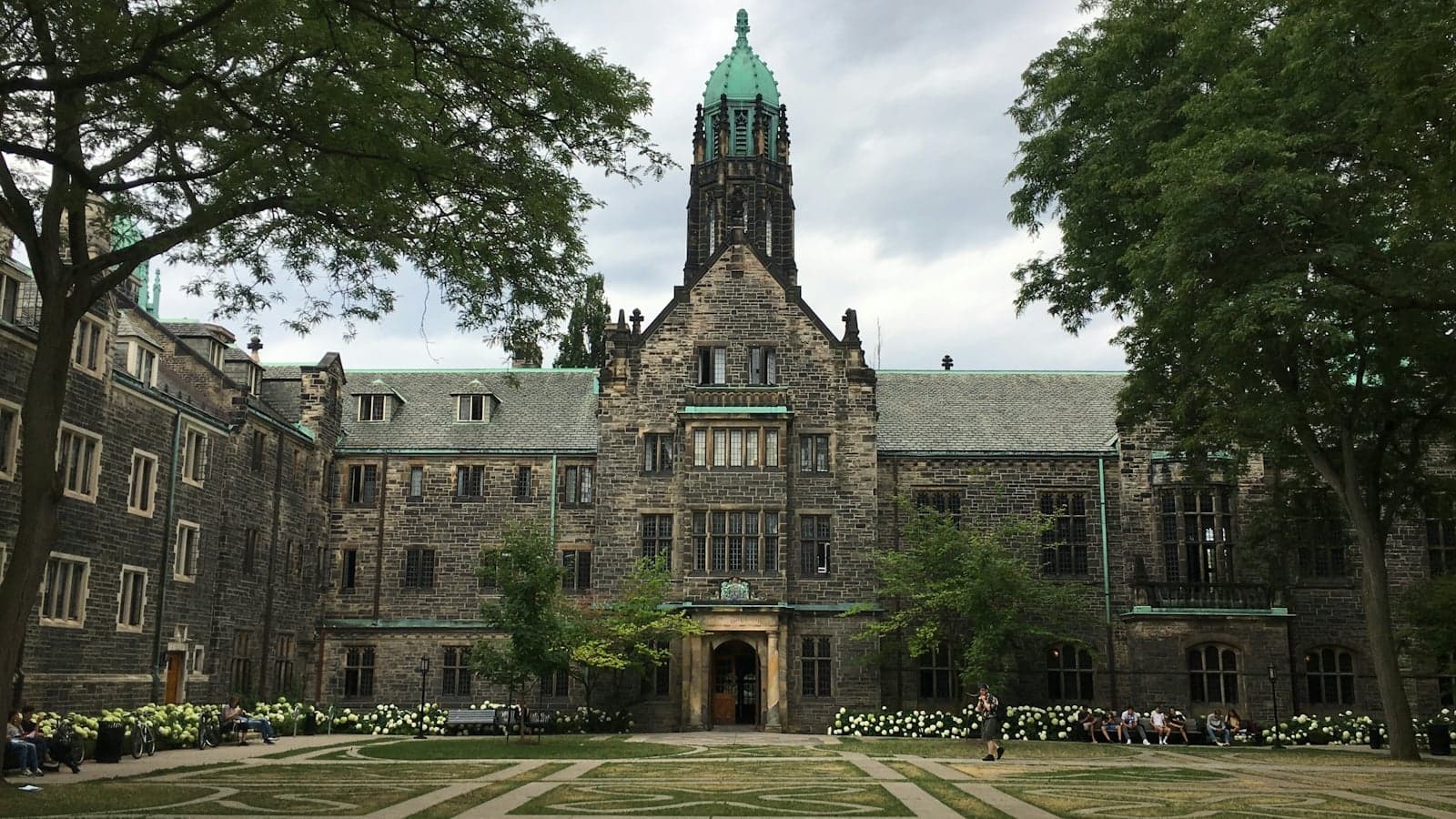
Short answer first: you register with an office, not with a professor. At UBC it is the Centre for Accessibility, at the University of Toronto it is Accessibility Services, at McGill it is Student Accessibility and Achievement, at Queen's it is QSAS. Each wants documentation from a licensed professional who can diagnose your condition, an online intake form, and a meeting with an advisor. Then you send a letter of accommodation to each instructor yourself. Booking an accommodated exam is a separate deadline again: 7 days at UBC, 14 days at Toronto and McGill, and at Queen's registration with QSAS by 15 November or 15 March.
Every rule below comes from the university's own page. The office names, the portals and the deadlines change from campus to campus, so treat this as the shape of the process and check the two or three dates that apply to you.
What does the law actually require?
Provincial human rights law, not the university's goodwill. The Ontario Human Rights Commission's policy on accessible education states that education providers have "a legal duty to accommodate the needs of students with disabilities" under the Code, and that the duty ends only at the point of undue hardship, which it treats as a high bar. Two other principles in the same policy matter more to you day to day. Accommodation is a responsibility shared by all parties to the process, and the policy also gives an education provider a duty to inquire and offer help where it has reason to think a student needs it, even without a request. In practice, every office in this article still starts with a form you fill in. And students are assessed individually, which is why two people with the same diagnosis can end up with different plans. Recording a lecture is one of the accommodations that comes out of this, and it has its own rules, covered in recording lectures in Canada.
- Each province has its own statute. UBC's calendar grounds its accommodation duty in the British Columbia Human Rights Code rather than in Ontario's, and the Alberta, Quebec and Nova Scotia equivalents say much the same thing in their own words. The wording differs; the duty does not.
- The limit is the essential requirement. The same UBC calendar entry says that accommodation "shall not remove the need for evaluation and the need to meet essential learning outcomes". You get a different route to the same standard, not a lower standard.
- In practice, nobody comes looking for you. The duty to inquire is real, but every office in this article starts with a form you fill in, and nothing moves until you do.
That last point is the one that costs students a term. The law is on your side throughout, but a plan only exists from the day you register, and nothing is in place for the six weeks before that.
Which office do you go to, and what do they want?
The four processes below are close enough that learning one teaches you all of them. The names and the software are what change.
| University | Office | Portal | First move |
|---|---|---|---|
| UBC Vancouver | Centre for Accessibility | ClockWork, with your CWL | Gather documentation, then submit the information form |
| Toronto, St. George | Accessibility Services | Student Intake Form and AS Portal | Get a Certificate of Disability completed, then submit the intake package |
| McGill | Student Accessibility and Achievement | ClockWork | Book an advisor appointment, then upload documents |
| Queen's | QSAS | Ventus, with your netID | Log in, complete the intake form, upload documents |
UBC's registration page sets out four steps: check that your condition is one the Centre supports, gather medical documentation from "a professional who is qualified to diagnose your specific disability or medical condition", complete an information form in ClockWork with your Campus Wide Login, and book and attend an initial meeting with an Accessibility Advisor. Some students are confirmed through express registration instead of a meeting.
The University of Toronto's requirements page is more prescriptive about paperwork. The core document is a Certificate of Disability completed by a health care practitioner who is familiar with your disability, whose scope of practice includes it, and who is licensed to make the diagnosis. ADHD, learning disabilities and autism spectrum disorder need a psycho-educational or neuropsychological assessment instead. The Student Intake Form is filled in online in one sitting, with no option to save and come back, so collect everything first.
McGill asks you to book the appointment first and upload your documentation no later than noon on the business day before it. Its list of what the letter must contain is the most useful checklist in the set: the clinic's or professional's official letterhead, a clear diagnosis or clinical description, an explanation of how the condition currently affects your academic performance, the professional's full name, designation, licence number and signature, and the dates of assessment or treatment, in English or French. If you had accommodations somewhere else, a letter from that institution's accessibility office naming the accommodations you received counts as evidence too.
Queen's runs the whole thing through Ventus. You log in with your netID, complete the intake form, upload your documents, and QSAS asks for 4 to 5 business days to review them before it emails you about an intake appointment. Queen's is also the most explicit about the awkward case where you are still on a waiting list for an assessment: a student experiencing a barrier related to a disability or impairment, whether currently documented or awaiting documentation, may still be eligible.
The documentation itself
The Ontario Human Rights Commission draws a line here that is useful to know. An education provider is entitled to objective information about your disability-related needs from a qualified professional, and is not entitled to a fishing expedition through your medical history. In practice that means the letter should be about function rather than biography: what you cannot do under exam conditions, how long you can sustain reading, what a flare-up does to a deadline. If your doctor writes two lines saying you have a condition, the office will send it back.
Two practical notes. Getting an assessment is the slow part of the whole process, so book it the day someone first suggests it and ask the accessibility office what it will accept while you wait. Federal and provincial student aid can also fund disability-related equipment and services once you are registered, which is a separate application and a separate article.
How long does registration actually take?
Long enough that starting in October is starting late. Queen's suggests registering as early as mid-June, and then needs its 4 to 5 business days for documents plus an appointment slot. UBC says plainly that registration is a multi-step process that can take some time, and asks students to begin as early in the term as possible. McGill encourages new students to book an appointment before their first semester starts.
Toronto is the one that puts hard dates on it. Its registration deadlines for 2026/27 are 13 July 2026 by 5 p.m. if you want accommodations in place on the first day of the fall term, 9 October 2026 by 5 p.m. for accommodations during the fall term and its final exam period, and 12 February 2027 by 5 p.m. for the winter term. You can register at any time, but the page is direct that accommodations are not guaranteed to late registrants.
Add the pieces and the real timeline is clear. The appointment with a doctor or psychologist takes weeks. The office's review takes days. The advisor's calendar takes another week or two. Then the letter has to reach your instructors and, for exams, another deadline starts. Nothing in that chain is fast, and none of it can be compressed in the week before a midterm.
What do accommodations actually cover?
More than extra time, and less than a free pass. UBC's guidance on Policy LR7 gives concrete examples: extended time to write exams and a distraction reduced or private space for them, access to early course registration, a part-time schedule in a practicum or clinical component of a program, and audio recording of lectures. Other common items across Canadian universities are note-taking support or shared class notes, course materials in alternate formats, assistive technology, captioning and interpreting, and flexibility on deadlines.
- Extra time is the most common and the least interesting. It is usually expressed as a multiplier on the published exam length, and it is the accommodation the exam centre handles for you once you have booked.
- A separate room is not always a private room. Most centres run a shared low-distraction space, and a genuinely private room is a separate approval.
- Note-taking support means someone else's notes. It is a backstop, not a system, because another student's notes are shaped by what that student already understood. The methods that fill the gap are in notes for tutorials and labs at Canadian universities.
- Deadline flexibility is negotiated, not automatic. It normally arrives as a stated maximum extension you may request, and you still have to ask before the deadline passes.
- Some accommodations need the instructor. Queen's says outright that some accommodations require students to communicate directly with their instructor for implementation. The letter opens the door; the conversation is still yours to have.
Recording deserves one line rather than a section, because it is the accommodation with the most conditions attached to it and those conditions are set out in full in the article linked above.
When do you have to book an exam accommodation?
This is where most accommodated students lose marks, and it has nothing to do with disability. Registration and exam booking are two different deadlines, and the second one is short.
| University | Term tests and midterms | Final exams |
|---|---|---|
| UBC Vancouver | At least 7 days before the exam date | At least 7 days before the formal exam period begins |
| Toronto Mississauga | No later than 14 days before the test date, through AIMS | Friday 20 November 2026 at 4 p.m. for the December 2026 exams |
| McGill | At least 14 days before the assessment | At least 14 days, applies to all timed assessments |
| Queen's | Booked in Ventus once QSAS has approved them | Register with QSAS by 15 November for December exams and 15 March for April exams, after which they are applied automatically |
UBC's exam accommodation page also sets out how the day itself runs: arrive 15 minutes early and ready to start, and a student who arrives more than 30 minutes after the class start time will not be permitted to write. Toronto Mississauga puts the December 2026 final exam deadline at 4 p.m. on a named Friday in November, which tells you something about how firm these dates are. Queen's exams office asks you to register with QSAS by 15 November for the December exams and 15 March for the April exams, applies approved accommodations to centrally scheduled finals automatically through Ventus, and charges 45 dollars for an accommodated exam you neither write nor cancel at least 24 hours ahead.
Put the deadlines in the calendar in week one
Work backwards from your syllabi, which in Canada publish the assessment dates before the enrolment deadline. The exam period dates and the shape of the two-term year are in planning your study around the Canadian academic year.
- Write down every test, midterm and final for every course, with its date.
- Subtract your university's notice period from each one and put that day in the calendar as the real deadline.
- Put the final exam booking deadline in separately, because it is a single fixed date and not a rolling count.
- Set a reminder a week before each of those, not on the day.
- Book everything you can in the first fortnight, while the term is quiet.
What if an instructor pushes back?
It happens, and it is usually confusion rather than refusal. The route is back through the office, not into a debate with the instructor about your condition.
UBC's Policy LR7 guidance is the clearest statement of who decides what. The Centre is responsible for deciding which accommodations are offered, instructors have a responsibility to implement them once notified, and if discussions with the Centre do not resolve an instructor's concerns, the matter is referred to the Registrar for academic accommodations or to the Administrative Head of Unit for non-academic ones. If you disagree with the Centre's own decision about your accommodations, that is a different route: there is an appeal process under the policy. Queen's academic accommodations procedure sets the same expectation from the other side, requiring instructors who have concerns to consult QSAS immediately rather than acting alone.
So the practical sequence when an instructor says no is short. Email your advisor the same day, quote what was said, attach the letter you sent, and ask the office to handle it. Do not renegotiate your accommodation in a hallway, do not explain your diagnosis to justify it, and do not accept a substitute worked out on the spot. The office is the party with the authority and the practice at this.
What does an accommodation not do?
It does not change the standard you are being measured against. UBC's calendar entry is explicit that accommodation does not lower academic standards and does not remove the need to meet essential learning outcomes, and every other Canadian university says a version of the same thing. A degree that requires you to give a clinical presentation still requires it; the accommodation changes how, not whether.
It is also not normally retroactive, not a substitute for academic consideration when you are ill, and not automatically portable between campuses of the same university. The grading rules and the deferral routes that cover illness are a separate system, described in how Canadian university exams work, and you may need both.
How do you study with the plan you have?
The accommodation removes a barrier. It does not do the learning, and the two things students most often get from an accommodation, extra time and someone else's notes, are both weak on their own. Extra time in an exam only helps if you have something to retrieve. Another student's notes only help if you turn them into questions you answer from memory, which is active recall.
A term that works looks roughly like this. In week one you send your letters and book every test you can. In each teaching week you turn that week's material into questions while it is fresh, because catching up later costs more than it does for other students, not less. Before each exam you use the extra time you have been granted to rehearse under the conditions you will actually face, in the same room type, with the same clock. The plan is on paper by the end of September or it is not a plan.
Where Notibo fits
The gap an accommodation often leaves open is the lecture itself. Note-taking support arrives late, covers some courses and not others, and gives you a record of what somebody else thought was important. Notibo records a lecture, or takes an audio file you upload, and returns a transcript, structured notes and flashcards with spaced repetition, so a class you could not write through still becomes something you can review. It also turns PDF, PPTX and DOCX files into notes and flashcards, which covers slide decks and readings. It transcribes 89 languages, and the transcript is in the language spoken. Pro is free to try for 14 days with no card, and the trial includes 240 minutes of recording. Afterwards the free plan covers 30 minutes of recording a month. Pro is EUR 9.99 a month or EUR 88.99 a year, in euro, with the local amount shown at checkout. Uploads are capped at 50 MB, and long recordings are saved in smaller parts as they run and joined back into one transcript. Files are stored in the EU on Supabase in Frankfurt, while transcription and the AI notes run on US processors under standard contractual clauses.
Recording a class needs permission, and an accommodation that covers recording is the cleanest way to have it. Ask your accessibility office first, and read your letter before you press record.