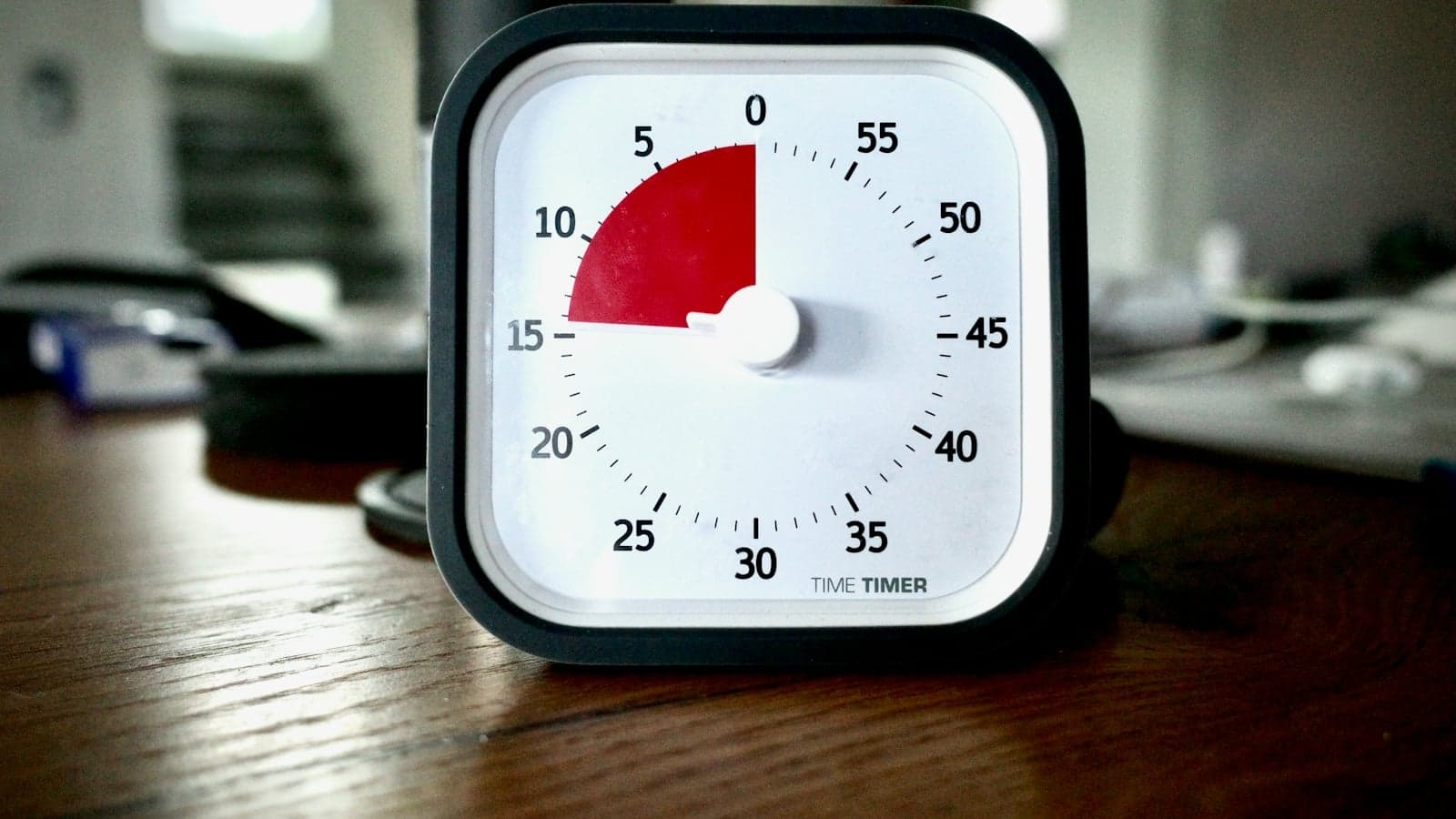
Short answer first: the Pomodoro technique is 25 minutes of uninterrupted work followed by a 5 minute break, with a longer break after four rounds. The timer is not the clever part. The clever part is that you decided in advance when you are allowed to be interrupted.
What is the Pomodoro technique?
Francesco Cirillo came up with it in the late 1980s using a kitchen timer shaped like a tomato, which is where the name comes from. A basic timing routine fits in four lines:
- Pick one specific task.
- Set a timer for 25 minutes and work only on that task.
- Take a 5 minute break when the timer goes off.
- After four rounds, take a longer break. Choose a length that lets you return ready to work.
You can try that routine without buying an app. Cirillo's own site describes the full version as more than a timer, with daily planning, a way of handling interruptions and a habit of estimating how many rounds a task will take. Those three additions are what turn a kitchen timer into a study system, and they are covered below.
What can a timer help with?
A timer provides a boundary for work and breaks. It does not establish that shorter sessions are always better.
Attention needs a change, not a longer effort
You will often hear that concentration drops after 20 minutes. A 2016 review found the evidence for any fixed number is thin. Some experiments support brief changes of task. In a 2011 study in Cognition, participants who twice switched from a 50-minute vigilance task to recalling memorised digits maintained performance, while the control group declined. That was a laboratory vigilance task, not a comparison of 25-minute study blocks with every alternative. Use it as limited evidence for changing activity, not proof of a universal lecture-attention limit.
The timer makes the task smaller
"Read chapter 4" is a task with no visible end. "Read chapter 4 for 25 minutes" has one, which can be useful when starting feels difficult. A round has a beginning, an end and a size you can see.
Interruptions become a decision
Once you have decided the phone is off limits for another 18 minutes, picking it up becomes something you choose rather than something you do without noticing. Keep essential contact or access arrangements available while reducing avoidable interruptions.
How do you run your first pomodoro?
Pick one specific task, not a subject. "Statistics" is not a pomodoro. "Work through problems 3 to 6" is.
Put your phone somewhere you cannot reach without standing up. Not face-down next to the book.
Start the timer and go. When something else surfaces mid-round, an email you owe someone, a book you need to return, write it on a piece of paper beside you and get back to the task. You deal with the paper in the break. This is Cirillo's interruption rule, and it is the part beginners skip.
When the timer goes, take the break. The standard method uses planned breaks. Check whether that rhythm helps you return to the task, and adjust if necessary.
What should you do in the breaks?
Choose a break you can finish at the planned time. If scrolling tends to stretch five minutes into half an hour, try a different activity.
Stand up. Get water. Look out of a window for thirty seconds. Stretch your back. Use whatever is comfortable and restorative for you; there is no guaranteed effect by the second round.
How long should a pomodoro be?
25 minutes is a starting point, not a law.
If you are writing something where it takes a while to get into the text, you could try 45 or 50 minutes with a 10-minute break. If you are facing something you really do not want to start, set the timer for 10. A short round you actually begin beats a long round you postpone until tomorrow.
Experiment for a week and keep the length where you most often reach the end without glancing at the clock.
A worked example: a study afternoon in six rounds
Here is an illustrative Tuesday afternoon. The plan was written the evening before, which is Cirillo's planning step.
- 13:00, round 1. Statistics problems 3 to 6. Two notes land on the interruption paper: reply to Anna, check the bus times. Break: water, window.
- 13:30, round 2. Problems 7 to 9. Problem 8 will not go. One line written down about where it got stuck. Break: stretch, reply to Anna.
- 14:00, round 3. Close the book. Write out everything from this morning's lecture from memory, then check. That is active recall, and retrieval practice has evidence for delayed retention. It does not guarantee that this round is more valuable than every other task. Break: walk to the kitchen.
- 14:30, round 4. Fifteen flashcards from what round 3 got wrong. Long break: 20 minutes outside, phone allowed.
- 15:15, round 5. Revisit problem 8 with a worked example, then attempt a comparable problem without the solution.
- 15:45, round 6. Read the first half of chapter 5, ending with a five line summary instead of a last page.
The six work rounds total 150 minutes. With three five-minute breaks, a twenty-minute break after round four and five minutes after round five, the session runs from 13:00 to 16:10. Writing down the estimate and the actual is the third of Cirillo's habits, and comparing several sessions can help with planning a week.
The mistakes that kill it
The first is planning too many rounds. Choose the number from the time and energy you have, rather than copying someone else's daily quota.
The second is skipping breaks because the work is flowing. If breaks keep disappearing, reduce the scheduled workload or try a different interval.
The third is using the timer without a learning task. Reading may be necessary for a new concept; follow it with a question or worked example and check your understanding. Active recall is one useful part of that cycle.
The fourth is running the timer on the phone with notifications on. The tool that is meant to protect the round becomes the thing that breaks it. Flight mode, or a real timer.
Pomodoro handles the hour, not the week
Cirillo's full method includes daily priorities and weekly planning. Connect the timed sessions to a study schedule built around tasks rather than hours.
The two fit together well. The schedule identifies priorities. The timer helps reserve time for attempting them; completion still depends on the task and the time it needs. If the rounds keep going to the wrong task, the problem is upstream, in a study environment that leaves too many decisions open.
Let the notes take care of themselves
A session can disappear into formatting when the intended task was practising. You sit down with a recording or a pile of messy notes, and the 25 minutes go on moving text around instead of understanding it.
Where your course permits recording and AI processing, Notibo can draft notes and questions. Reserve part of the first session to check them against the source before using them for practice. Recording-generated flashcards and spaced repetition are Pro features included in the trial; individual generated cards cannot currently be edited.