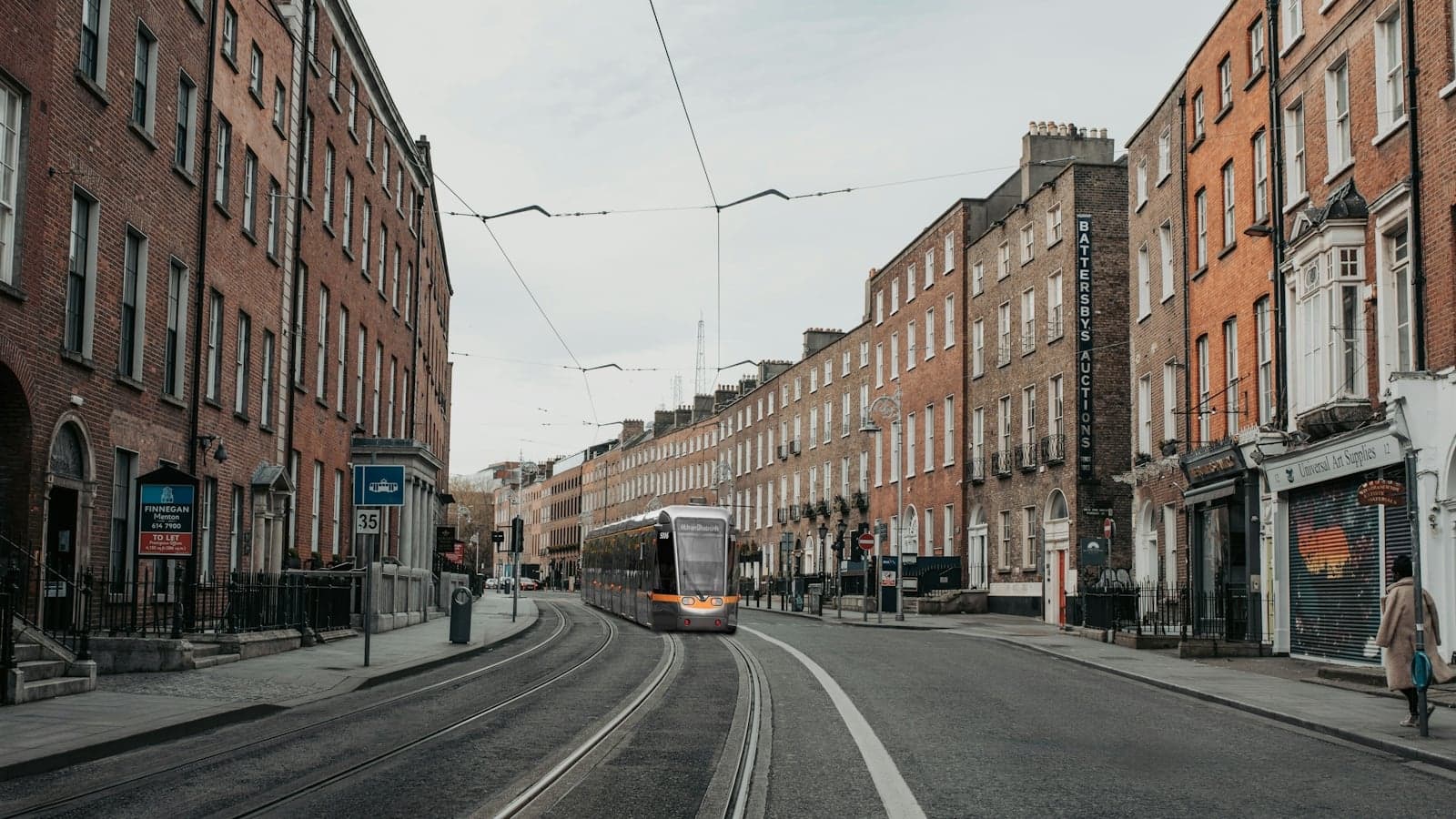
Short answer first: commuting is the normal Irish student experience, not the exception. The Central Statistics Office counted 201,200 students aged 19 and over travelling to college in April 2022, with an average travel time of 37.1 minutes each way and an average of 53.9 minutes in Wicklow. The HEA's Eurostudent 8 report puts it at 52 minutes for students living with their parents against 17 minutes for students in student accommodation. Across a twelve week semester that difference is about 70 hours. You get it back by studying on the bus and between lectures, not at home.
This is not a piece about how to enjoy your commute. It is about where the hours went and which of them you can take back, with the arithmetic shown so you can redo it for your own timetable.
Why do so many students in Ireland commute?
Because living at home is what most Irish students can afford, and because the sector was built around a small number of cities. The Eurostudent 8 report for the HEA, which collected about 21,000 responses from a student population of roughly 240,000, found that 45 percent of all students live with their parents or other relatives, rising to 53 percent of full time undergraduates.
The money explains most of it. The HEA's summary of the same survey records accommodation as the largest single item of student expenditure, at about 35 percent of everything students spend, with an average monthly accommodation spend of 469 euro. Average monthly income across all students came to 1,122 euro against average monthly expenditure of 1,340 euro. When a third of students are reporting serious financial problems, a 50 minute commute is not a lifestyle choice.
Two more facts from the census are worth having in your head before you plan anything:
- Where you study changes the trip more than who you are. Eurostudent found students at Dublin based institutions averaging 46 minutes, against 34 minutes for students at institutions outside Dublin.
- The county matters most of all. The CSO's Census 2022 figures give the shortest average commute to college as 20.9 minutes in Galway City and the longest as 53.9 minutes in Wicklow, followed by 52.1 minutes in Meath.
- Most people are moving at the same time. The CSO found 54 percent of students aged 19 and over left home between 7.31am and 9am, with a further 16 percent before 7.30am.
None of that is fixable in September. What is fixable is the timetable you build on top of it, and that depends on your own university's shape, which you can read off the Irish academic year.
What does the commute actually cost you?
Do this sum with your own numbers rather than taking the average. Here it is with the Eurostudent figure for students living at home.
Fifty-two minutes each way is 104 minutes a day, which is 1 hour 44 minutes. Five days of that is 8 hours 40 minutes a week. Across a twelve week teaching semester it is 104 hours. Run the same sum for a student in accommodation at 17 minutes each way and you get 34 minutes a day, 2 hours 50 minutes a week, and 34 hours a semester. The difference between the two is about 70 hours.
Now put that against the study side. The Eurostudent findings put personal study at about 18 hours a week for undergraduates. Seventy hours is therefore close to four weeks of a typical undergraduate's independent study, gone into a bus seat. That is the real number, and it is larger than most people guess.
Two things follow, and only one of them is obvious.
- The obvious one. Any of that time you can convert into study is worth a lot. Twenty usable minutes a day, five days a week, twelve weeks, is 20 hours a semester.
- The less obvious one. The commute also eats the hours at either end of it. A 7.15am departure and a 6.30pm return does not leave a fresh evening behind it. Assume the evening is worth less per hour than a morning gap on campus, and plan accordingly.
Can you build a timetable you can commute to?
Partly, and the window for it is the first two weeks. After that your groups are allocated and nothing moves.
The movable parts are usually electives, tutorial groups and lab slots. Ask your school office directly whether your tutorial and lab allocations can be grouped so that your contact hours fall on fewer days. The answer is often no, and sometimes it is a partial yes that saves you a whole day.
Cluster the days you can cluster
The prize is worth the awkward email. One day removed from your week is one return trip removed. At 52 minutes each way that is 1 hour 44 minutes a week, and across a twelve week semester it is about 21 hours. It also gives you one full uninterrupted day at home, which is the only kind of day long enough for an assignment.
The catch is that the timetable you see in week one is not final. DCU's timetable guidance says draft timetables are subject to change, and warns that a personalised timetable saved on its system does not automatically update when activities are added or removed, so you have to re-save it periodically and especially in the first few weeks of term. Most Irish universities behave the same way. Three practical consequences:
- Check the live timetable, not the screenshot you took in September.
- Do not sign a fixed work rota until the timetable has settled.
- Keep the return train or bus times in the same calendar as the lectures, so a 5pm lab and a 5.10pm last bus collide on screen rather than in real life.
Then check the library before you rely on it. UCC Library's opening hours page states that hours vary during holidays, examination periods and other times of the year and asks you to check the calendar before travelling, and it publishes a live view of Boole Library occupancy. For a commuter that is not a small detail. Arriving to a closed or full library after an hour on a bus costs you the whole evening.
What study works on a bus, and what does not?
The question is not how long the trip is. It is how long the uninterrupted stretches inside it are. A bus that stops every four minutes is not a 45 minute block, it is eleven four minute blocks with luggage and announcements in between.
So match the task to the interruption pattern:
- Works. Flashcards and self-testing, because each item is a few seconds long and losing your place costs nothing. This is active recall in the only form that survives a bus.
- Works. Listening back to a lecture with headphones, which needs no hands and no table.
- Works. Re-reading a summary you wrote yourself, because you already know the shape of it.
- Works. One question written on your phone before you arrive: what am I doing in my first campus gap today.
- Does not work. First contact with new material. You will read the same paragraph four times.
- Does not work. Anything that needs a structure written down, an essay plan included.
- Does not work. Problem sets with working out, unless you have a table and a seat you can count on.
- Does not work. Reading on a moving bus, for a lot of people, for plain physical reasons. Audio is the safe medium if that is you.
A train is a different proposition from a bus. If you have a seat, a table and 40 uninterrupted minutes, you have a real study block and you should treat it as one rather than as dead time.
How do you use the recordings on the way home?
If your lectures are captured, the homeward trip is the natural place to use them, and it is the single biggest advantage a commuter has over someone who walks ten minutes home and does nothing until eight o'clock.
Whether the recording exists at all is not a given. Which system your university runs and how long the file stays online varies by institution and often by individual lecturer, so settle that in the first fortnight rather than discovering in May that semester one was never recorded.
When it does exist, do not replay the hour. Replaying an hour to save an hour is not a saving. The method that works on a bus is short and targeted, and it is covered in more detail in studying from recorded lectures:
- Before you play anything, write the two moments you lost in the live lecture.
- Jump to those, at a speed you can follow, and fix them.
- Turn what you fixed into two or three questions with answers.
- Stop. The rest of the trip is for the flashcards you already have.
What do you do with each part of a commuting day?
A commuting day has about six distinct parts, and each one is good at something different. Most people use all six the same way, which is why they feel like the whole day was wasted.
| Part of the day | Use it for | Do not use it for |
|---|---|---|
| The walk to the stop or station | One decision: what your first campus gap is for | Anything on a screen |
| The trip in | Flashcards, or listening to yesterday's recording | New reading, essay planning |
| The gap before your first lecture | The hardest single task of the day, while you are fresh | Email, queueing for coffee |
| Gaps between lectures | Processing the lecture you just sat through, into questions | Going home early because the gap is awkward |
| Lunch | Eating away from a screen, and one social thing | Skipping it and crashing at 3pm |
| The trip home | Replaying the two moments you lost, then flashcards | Deciding you will do it all tonight instead |
| The evening | One planned task, finished, then stop | Open-ended catching up |
The row that changes the most for people is the fourth. A one hour gap between lectures feels like nothing, so it gets spent. Two one hour gaps on three days a week is six hours, which against an 18 hour weekly personal study average is a third of the whole thing, and it is time you have already paid for with the trip.
Where to eat and where to work
Pick both in week one and then stop deciding. The decision itself is what costs you the gap.
- A default seat. One library floor, one quiet corner, one department common room. Go there without thinking. If the library is full at 11am on a Tuesday, know where you go instead.
- Food you brought. A bought lunch five days a week is the largest avoidable cost in a commuting week, and it is also 20 minutes of queueing. Find the microwaves and the common rooms with kettles on your campus; almost every Irish university has them and none of them are signposted.
- A locker or a heavy bag policy. Commuters carry the whole day with them. Decide what actually needs to travel.
- A charger and a plug you know about. A dead phone on the way home takes the recording and the flashcards with it.
Does the student travel card save you anything?
Yes, and a lot of students apply late. Transport for Ireland states that if you are aged 19 to 25, or a student in full time training or education, you can get 50 percent off public transport fares with a valid Young Adult or Student Leap Card. There are two different cards and people apply for the wrong one.
| Young Adult TFI Leap Card | Student TFI Leap Card | |
|---|---|---|
| Who | Everyone aged 19 to 25 | Full time students aged 16 to 18 or 26 and over |
| Course conditions | None, age is enough | At least 15 hours a week, at least 6 months or 25 weeks |
| How you apply | Entirely online, with a photo ID and a live selfie | Apply online, then collect from a Student Leap Card agent |
| Online courses | Not relevant | Not eligible |
The Leap Card scheme's own page sets out what the half price fares cover: single trips on Bus Éireann, Dublin Bus, Iarnród Éireann including the DART, Go-Ahead Ireland, Luas, TFI Local Link services and a list of commercial bus operators. Full time international students who meet the criteria can apply, uploading an acceptance letter from an Irish university in English or Irish. Fares, caps and ticket types change, so read the current fare pages on the Transport for Ireland site rather than a figure from a forum.
When should you stop commuting and move closer?
When the arithmetic says so, not when you are tired of it. Work out your own hours first: minutes each way, doubled, times the days you are on campus, times the teaching weeks. If that number is over about 80 hours a semester and your continuous assessment marks are slipping, it is a real problem rather than an inconvenience, and it is worth pricing a move against.
What digs actually are
Ireland has a midweek option that is not a full lease. The Department of Further and Higher Education promotes the Rent-a-Room Scheme to homeowners with a spare room, and eligible participants may earn up to 14,000 euro a year tax free under it, subject to the scheme's terms. That relief is the reason digs exist in the volumes they do. The department publishes a practical guide, a digs checklist, a voluntary regulatory framework and a sample licence agreement for 2026-27.
Two things to understand before you take a room. The agreement the department publishes for this is a licence agreement rather than a tenancy agreement, so read it properly and agree the ground rules in advance. And the research the department cites on that page found that meeting the student and their parents in advance and agreeing ground rules was a feature of successful arrangements, with almost nine in ten digs homeowners already doing it.
The middle path is underrated: digs for three or four nights a week, in the worst semester only, rather than a year long lease. That is enough to remove the early starts before your heaviest days while keeping the weekends at home. Count the hours you save, not the nights you pay for, and set the deadline for the decision at the start of a semester rather than in the middle of one, because moving during the run up to Irish exams is a bad idea whatever the commute is.
Where Notibo fits
The part of a commuting week that breaks first is the processing: turning a lecture into something you could be tested on, while the bus is moving and your hands are full. Notibo records a lecture, or takes an audio file you upload, and returns a transcript, structured notes and flashcards with spaced repetition, so the trip home has something to review instead of an hour of raw audio. It also turns PDF, PPTX and DOCX files into notes and flashcards. It transcribes 89 languages, and the transcript comes back in whatever language was spoken.
The limits, plainly: uploads are capped at 50 MB, and long recordings are saved in smaller parts as they run and joined back into one transcript. Pro is free for the first 14 days, with 240 minutes of recording and no card. After the trial the free plan covers 30 minutes of recording a month, and Pro is 9.99 euro a month or 88.99 euro a year. Files are stored in the EU, on Supabase in Frankfurt, while the transcription and the AI notes run on US processors under standard contractual clauses. Recording a lecturer needs their permission first, and no app changes that.